Tuesday, October 31, 2006

Special witchcraft edition

One of my favorite things about Lobito is the packs of goats that roam the streets, looking for garbage to eat. The packs total up to 15 and there is always one clear leader that the others run after. My other experience with goats was in Honduras. In Honduras, there was no way you could let your goats roam free; your neighbors would see them and think, “Vamos a almorzar cabrita!” ("We're having goat for lunch!") I thought Lobitanos were very respectful of private property- until I learned the REAL reason that no one takes the goats: bruxeria (witchcraft)! Yes, if you take a goat that is not yours, you will fall prey to witches. Those little baby goats running around look innocent, but now I know better.

Witches don’t limit their spells to goats. If you lend someone money and later ask for it to be repaid, that money will be hexed and only bad things will befall you: bruxeria! So be very careful when lending out money.

Monday, October 30, 2006

TV or not TV?

I spent around 20 hours this weekend with colleagues working on a grant proposal to secure funding from the US State Department. We are desperately in need of funding. NGOs in general are having a hard time getting funding for projects in Angola because donors know that the Angolan government is filthy rich (at least compared to other developing countries) and can afford to fund the majority of development initiatives in this country. The US and European governments think, “Why should we give Angola more money? They have plenty in their oil coffers.” Understandable, but what you see on paper does not reflect the reality in Angola. Yes, the Angolan state is rich; but no, they do not share that money with the Angolan people in the form of development projects.

We as an organization have an added burden because we have an institutional policy that prevents us from taking money from oil companies. Other international NGOs admire our position- there is a lot of conflict surrounding oil money and many NGOs have a guilty conscious about taking it. Since we do economic justice and advocacy work regarding oil and other extractive industries (diamonds, for example), it would be a conflict of interest for us to take money from those companies. This is great in principle; but not so great when it comes to the practicality of US government grants. The US government currently offers many grants through public-private partnerships. In Angola this means you can get, for example, a USAID grant with money from the US government and Chevron. As a result, we cannot apply for a lot of grants.

So this State Department grant is a big deal; we really need the money and expand our programming areas. This is all a very long explanation for the current internal debate I am having. We did most of the work at the country director’s (Juan) house. He has satellite cable with English language channels. I was with Juan a few weeks ago when he signed the contract for the cable and asked him how much it cost per month. He answered, “US$400” which I thought was a bit much; I quickly got rid of any desire to have cable and give up my two fuzzy Angolan options.

As we were working this weekend, we would take breaks to catch up on regional news: the airplane crash outside of Abuja, Nigeria and the elections in the Democratic Republic of Congo. Sergey, another colleague friend asked how much Juan paid for the cable. Suddenly the answer was $60! I was shocked! Apparently the $400 was the initial cost for the dish and the set up fee, and included 3 free months of service.

Now, my dilemma is the following: do I get digital cable? Tell me what you think.
Here are the pros/cons:
PRO
· Something to kill the boredom, which is prevalent at nights and on weekends
· English language news (CNN, SKY, BBC)
· Entertainment (Brazilian telenovelas)
· Still have access to Angolan networks
· American movies and television series (The Daily Show!)
· Missing the $60/month wouldn’t be a problem since there’s nothing else for me to spend my money on
CON
· The $400 set-up fee
· $60/month means $60 less for vacation
· I would be watching TV ALL THE TIME, and probably read less

Thursday, October 26, 2006

Angola's poor progress on Millenium Development Goals

I came across an intersting report about Angola's progress on reaching the Millenium Development Goals. The article mentions the widening gap between rich and poor in Angola- notice the employer of the seven richest Angolans.

Tuesday, October 24, 2006

I Stand Corrected...

An Angolan friend has brought it to my attention that Jay-Z is only one in a long line of stars that has played Luanda. Missy Elliot, DMX, and Busta Rhymes among others have played here. So I ammend my statement to say that Jay-Z is the biggest star to play Angola since I've been here. Which of course means nothing since I've been here only 2 months! Either way, it was briefly exciting.

Also, the friend says that Unitel, the cell phone company, paid Jay-Z $500,000 to play here. I haven't been able to find any info on this, but it would not seem too out of the ordinary for this to happen. Oh well- there go all my hopes for celebrities saving the world!

Thursday, October 19, 2006

Jay-Z in Angola

Last week Jay-Z played a concert in Luanda- at the Karl Marx performance space, no less. In and of itself, this is amazing. As far as I know, no big name entertainer has played here. Rap is extremely popular among the Angolan kids, so this was a very big deal. At first I was a little surprised that Jay-Z would come to Angola. No one comes to Angola! (With the exception of Chris Tucker, the actor/comedian who came here to film part of the PBS series African American Lives, which is worth putting on your Netflix List.) It’s no longer a cause celebre, now that the war is over; it’s not as commercially powerful as other places, like South Africa; and it’s certainly not comfortable, even for the people rich enough to pay for the very best.

Then my friend Jade sent me a UNICEF release on Jay-Z’s work as a UNICEF ambassador. Jay-Z is making a tour of African nations and filming his travels as part of a MTV special on water access. I think this is great; he is a celebrity using his fame and abilities to bring attention to a development issue but not acting like a savior… and he didn’t even have to adopt an orphan!

(You can follow Jay-Z's MTV work in Angola here.)

Monday, October 16, 2006

Radical Thoughts on "Jovemania"

Sunday night I was sitting at home watching TPA-2; my choices were “Luanda da sorte” (literally, “Luanda Gives Good Luck”) the televised lottery and gift give-away program, or “Jovemania” (“Youthmania,” a variety hour for teens). I chose Jovemania because I need to stay hip while in Angola. Jovemania usually follows the same format of an Angolan music star lip-syncing to his or her latest hit and info sessions on topics that might be important to youth; past topics have included “The Internet,” “Sign Language,” and “Art in Angola.” Youth from high schools in Luanda fill two small bleachers and serve as the audience.

Sunday’s episode was interesting because the topic of corruption came up two separate times. Corruption is rampant in Angola. (Here is what Human Rights Watch has to say about corruption in Angola and here is what the Economist says.) Of the places where I have lived, Angola is by far the worst; it is expected and unchallenged. The first lip-syncing artist was Teta Lágrimas. He “sang” two songs, the last of which was called “Eu quero ser politico” (“I Want to Be a Politician”). Basically the song was about how his girl left him and he wishes that he was a politician because that way he could get whatever money, car, or power he needed to keep her. The song was pretty bold on its own; corruption is something people are frustrated with but have accepted and just deal with, so to hear an underhanded swipe at the government was a change. It was especially bold given that he was “singing” this song on a state-run television station.

The second thing to catch my attention came up during the info session. Today’s topic was “Youth Employment” and they had two men speaking, one from the government’s youth department and the other from a computer company that has a youth employment program. Both men were just generally talking about how high school student can go and find jobs. (These youth programs are only in Luanda; the other kids in the country are on their own!) After the government guy praised his program, the computer guy started talking about his company’s program. I didn’t catch how it came up, but he started talking about transparency and that none of the job applicants would have to worry about having to pay the gasosa. (Gasosa literally means soft-drink, but is more popularly known as a bribe. It took me a while to catch onto this usage; I didn’t understand why policemen would want soft-drinks when they could get money out of people!) The guy asked the audience, “How many of you know of anyone who got a job without a gasosa?” The teens, who are usually pretty quiet and bored stiff during these info sessions, suddenly perked up and shouted “No one!” and began chatting animatedly amongst each other. The computer guy said, “That’s illegal! You shouldn’t have to pay that! We need to start reporting these things so things can change in Angola!” The teens burst into applause. The government guy looked bored.

I’m not expecting any youth protests or changes in the corruption system, but it was nice to see, on public state-run TV, some complaints about the way things work here.

Finally, those familiar with my inexplicable aversion to all fish and seafood will be surprised to learn that I ate fish on Saturday night- and not just a bite or two! My coworker friend Mark is out agriculture program manager by day and a fisherman by night (really- he goes out any time of day, sometimes until 9 pm). When he heard about my dislike, he said, “If I catch you a fish, will you eat it?” I agreed and was safe for several weeks- the fish in the bay next to his house weren’t biting. Saturday, however, he invited several of us over for a fresh fish dinner. He made some chicken on the side, just in case, but I didn’t touch the chicken. The fish was coa- no one knew the English name- and it was quite tasty. I’m still not totally convinced that I like fish now, but I learned I can at least get through it without keeling over, which as a child is something I truly believed would happen.

[This is the view from Mark's front porch of Mark (yellow shirt)and Juan going out in the kayaks for some late afternoon fishing. Yes, this place could be worse!]

Friday, October 13, 2006

Two minutes of fame down, 13 left to go

Yesterday I attended a forum in Catumbela, a small comuna about 15 mintues away from Lobito. As a Fellow, I am usually sent to conferences, trainings, etc. because as an organization it's politically useful and usually I am the only one who has time to go to them. Either that or no one wants to go. Sometimes I have a hard time telling which one it is! Unfortunately, yesterday’s forum was one where I was checking my watch ½ into the event.

I had high hopes. The forum was organized by the Department of Family, under the Women’s, Demibolized Soldiers, Former Combantants’ and Veteran’s Program; apparently one office is enough to cover all groups. Its title was “Rural Women’s Provincial Forum: Investing in Women Guarantees Stability in Our Communities.” It was supposed to start at 9, but there was no action and around 10 am everyone started to get anxious. The governor of Benguela (the province where Lobito and Catumbel are located; also the name of a city 45 minutes away from Lobito) was supposed to come and open the session. It was a good example of the political sensitivity and respect for higher-ups that exist in Angola: there was no way the forum could start without this guy, but it was soon clear that the forum was not number one on the governor’s list of things to do for the day. At 10:30 the governor and his entourage rolled in- among them was my buddy from the last training I went to, the mayor of Lobito, who happens to be a huge professional wrestling fan (Hulk Hogan is his favorite). With his arrival, the forum officially started. A group of women and men from a nearby village paraded in with local products: fruits, vegetables, sugar cane, collard greens, a goat and a case of pineapple Fanta. (Not sure why the Fanta was thrown in there...) Then they performed some traditional dances, which was awesome because the elderly men and women were the most enthusiastic and really got into it. The governor gave a little speech and then was immediately on his way out the door.

Then the forum started. The schedule had listed all these topics regarding women’s issues: women and microcredit, women and the environment, women and health, and women and community development. Sounded great… except the people they invited didn’t speak about women, with the exception of the microcredit lady and a woman from Oxfam. At one point the man speaking about commercial leaders in rural areas said emphatically, “We need MEN to step up and act like MEN! We need entrepreneurial MEN!” Then he sort of caught himself and said, “Uh, and women, too.” Also frustrating was the complete lack of control over the speakers and those people questioning them. They collected all the questions to be answered, then read them and then every single panelist answered them regardless of the fact that the panelist before them had said the exact same thing! The questions posed were done in an open mic way; given that no one from the government ever really listens to anyone, local leaders and NGOs took the opportunity to voice their complaints vociferously. The result of all of this was that the lunch break, which was supposed to be at 1:00, did not happen until 3:00. I should have taken this as a sign that lunch was to be missed, but like everyone else I was ready for it when it came. Ready, that is, until I picked up my plate and saw chunks of hair (fur, really) on the several piece of pork that were in my stew. I just ate the rice. Luckily, a meeting to discuss a funding opportunity for a new project with one of our partners has come up for tomorrow morning, so I will have to miss the end of the forum.

The good to come out of the forum? A lot of the attendees from surrounding villages spoke in Umbundu, which I enjoy listening to- it's a very melodic language- despite not understanding a single word. I talked quite a bit with the microcredit lady, who had some interesting things to say about the future of microfinance in Angola. We exchanged phone numbers and she invited me to come visit some clients with her. And, continuing the trend I set in Honduras by appearing briefly on “X-0 Da Dinero” and my two friends’ commercials on Lencavision, I made it onto Angolan TV! The local news was at the event, and came up to me and stuck the camera right in my face. I wasn’t sure if I was supposed to look deep in thought and fascinated by the panelists, so out of sheer embarrassment I turned red, smiled, and kept looking at the camera as if to say, “hi, how are you?” (It was no more than two feet away from me and blocking my view of the speaker, so I really couldn’t do much else.) Sure enough, on the Benguela Province news hour, there I was. Today, Benguela local news; tomorrow, the world! (Or at least Angola...)

Tuesday, October 10, 2006

Armenia in Angola


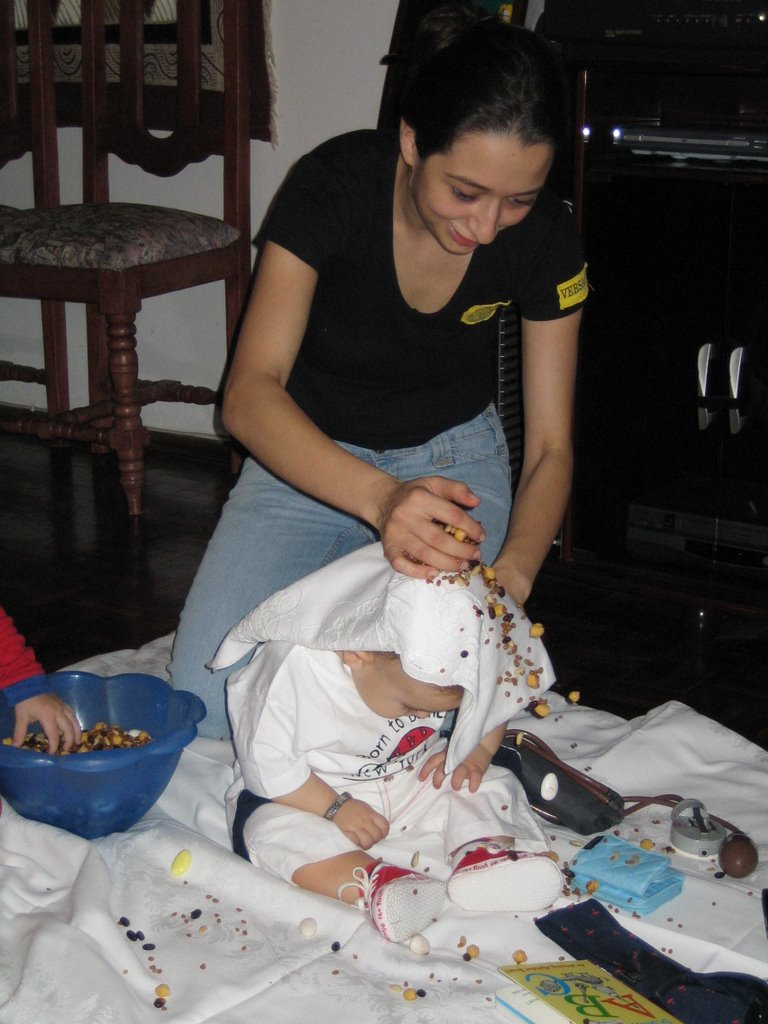
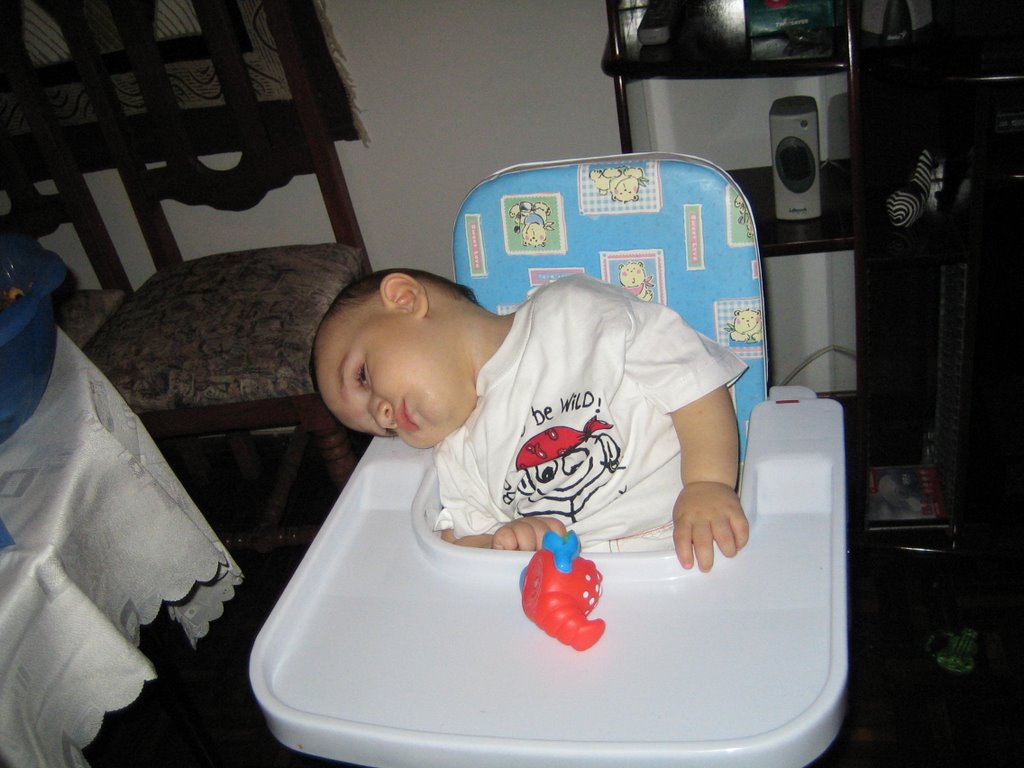
Last Friday was quite fun- my coworker, Sergey, and his wife, Stella, invited a few people over to their house to celebrate their son Aram’s first tooth. Stella, Segey and Aram are from Armenia. According to Armenian custom, when a baby starts teething, the family and friends hold a party to determine the future profession of the baby. They placed a white sheet on the floor and different objects that represent professions: a stethoscope, optical mouse, book, pen, soccer ball, etc. Stella then placed a white cloth on Aram’s head and put a mixture of grains, nuts, and chocolate on the cloth. This symbolizes the sustenance that he will need in order to become strong and healthy. Then Aram was free to choose his profession- as determined by the first thing that he picked up in his hands. At first he was distracted by all the nuts and grains, which he found to be quite tasty. However, he will follow in his father’s footsteps and become an IT specialist, since the first thing he grabbed was the optical mouse, and the second being the pen drive (Sergey loves technology and although it is not in his job description, is the go-to guy in the office for all things technical).

Tuesday, October 03, 2006

Working 8 to 6 (with an hour for lunch)

NOTE: Because this is a public forum, I won’t be naming my employer directly. You all know who I work for- if you want to ask me something specific, send me an email.

Several people have asked me to describe just what it is that I do. I’ve been here just over a month and I am finding my way in this fellowship, but I will give my general impressions so far. I’m finding that my responsibilities change as I finish one task or project, so this might all be different by the end of the month!

Basically, my job here is to learn as much as I can about the organization so that by the time my year is up (or before), I will slide right into a new job as a program manager. (Knock on wood.) I am not assigned to any one specific program, but am floating between all departments, including the finance department, to get a feel as to how they work. This is really a unique opportunity within the organization- project managers that don’t come through the fellowship program are forced to learn how the organization works while managing a project and its staff- I get to do this at my own pace and without having to supervise staff. My coworker Suzie manages the HIV/AIDS/TB prevention project and has really made clear to me how lucky I am to get to know the systems at my own pace. She was thrown into a several-thousand dollar project without more than a two week orientation; what is effectively my year-long orientation will give train me to be a better manager in the future.

So, what exactly am I learning? Currently I am working on a few projects. The most pressing is the task of closing the findings of our 2003 internal audit. Unless we as an organization address the findings, our “ranking” as a country program will slip. Many of the findings have been addressed already, but no one has had any time to report them back to headquarters. I am currently writing the memo that will be sent hopefully in the next two days.

Another project is writing a proposal to train our organization’s staff on HIV/AIDS issues. Addressing the world-wide HIV/ADIS pandemic is a top priority within the organization. The organization soon saw that the disease didn’t only hit the communities in which we ran projects, but that it hit staff as well- if not with staff members having the virus themselves, then by having family members and other loved ones die from it. (If you think of Botswana, for example, with its estimated 40% prevalence rate, then you can understand this realization.) They therefore developed a policy to reach all staff, teaching them about the disease, funding workshops, establishing a progressive insurance program for national staff, and other activities to raise awareness and fight stigmatization. As this is a new project, guaranteeing funding is a competitive process and I am writing the application to secure monies. We won it last year but had to forfeit funding because there were no qualified consultants available to give the trainings. I have been investigating the HIV/AIDS situation in Angola, local testing and treatment centers (VCTs) and helping formulate the project outcomes.

Another project I believe is the result of someone’s sick sense of humor- you might think so too if you read my previous posting. Today I was informed that I will now be the final signature on the vehicle logs. This is part of the financial learning process- double-checking mileage, making sure that the tanks of gas match the mileage and receipts, etc. I won’t have to compile any of this myself, just check all the reports once a month to make sure the assistant did them correctly, and sign off. Really- of all the finance projects to have me come in one, they picked the one thing that really makes my life difficult here: TRANSPORTATION!!!

Those are the projects I am currently working on. I will also be involved on some interesting projects in the next few weeks- participating in a “listening project” to gather lessons-learned from relief projects conducted during the war; helping to develop our strategic plan for the next five years (this is really interesting to me, because we are transitioning from post-conflict work to more traditional development projects; it will be interesting to see which direction this country programs goes into); assisting in the closure of our agricultural project (which involves selling off hundreds of yokes, hoes, and tractor tires); and others. Of course, there is the usual grunt work- last week my big project was making an organizational chart, and I have a stack of 35 agricultural manuals that I am punching holes into and making into binders. (The binders project is for my friend Mark, who has been really helpful to me, so I am doing this more as a favor than anything.)

Driving Me Crazy

As some of you may know, as a fellow I cannot drive due to liability issues. What you many not know, however, is that it is VERY difficult to get around without a car! I know in a previous post I talked about Angola driving- part of me is glad to not have to worry about crazy minivan taxis, wild motorcyclists, and children who dart across the street without even a look in either direction.

During the week, I get a ride with Tito, my coworker and neighbor. He is just a few yards away, so it is quite convenient- he usually takes me in the morning, at lunch, and at the end of the day. However, if Tito is out in the field, then I am out of luck. I can usually get a ride with another coworker who lives half a mile from me, but he rides a motorcycle home for lunch, so I can’t go with him then. And frankly, a lot of coworkers forget that I can’t drive or assume that someone else is taking me.

Going shopping is also difficult. Unlike other places where I have lived and work, there aren’t really any corner stores- bodegas or pulperias- that I can just run out to and buy something when I need it. (This is another result of the war- the mom and pop places were abandoned due to violence or had to close because there simply wasn’t any food to sell.) Again, I must rely on coworkers to take me to stores. For me, this is difficult for a variety of reasons. Although they have all insisted that I call them whenever I need a ride someplace, I still feel like it is an imposition to ask someone to drop what they are doing (on their days off, because that is the only time we have to go shopping, really) and take me places, especially because it is considered a personal expense that people pay out of their salary. (Not the biggest deal, given that gas is only US $0.50 a gallon here, but still...) Also, it is very difficult to go from completely independent to being completely dependent. It’s frustrating. There are rumors of a mountain bike in one of the warehouses, but it has yet to materialize. They do sell bikes here, but they are ridiculously expensive (around $350) and of horrible quality (no shocks!). Collective taxis- little minivans- are around, but I have been advised against taking them because of safety reasons. (For the usual poor-driver reasons, but also because some ex-pat women- wives of coworkers- have been harassed and robbed on them.) So basically I don’t go a lot of places other than the area where I live. This is okay, because I live in a nice neighborhood, but it does start to feel claustrophobic after a while.

Angolan Boob Tube

Angolan television is an interesting thing. There are two public Angolan stations, TPA-1 and TPA-2; both are run by the state. Several people have satellite cable, which carries several Brazilian and Potruguese channels, as well as CNN, Discovery, and others. If I were earning more I would pay for it, if nothing else because while at the hotel I got hooked on the Brazilian soaps currently showing on TV Globo. (If anyone knows what’s happening on Cobras e Largatos or Páginas da Vida, let me know!) However, I am receiving a fellowship salary, so I’ll stick to TPA. The first morning in my apartment I was looking forward to eating breakfast while watching TV, but there was nothing but static- no programs are broadcast until 8:30 am, and the program they show then is “As Seen on TV” which is an Angolan version of the Home Shopping Network. At night they show old soap operas (from the 80s) from Colombia or Mexico, or a couple of hours of music videos. Then of course there is the news, which is basically just an hour full of all the wonderful things the government is doing to help the people of Angola. The president's birthday was a few weeks ago, and they showed nothing but him blowing out the candles and programs about his life.

My favorite, however, is on the weekend when they show movies in English. These are not very good quality, but it is nice to hear English. For example, last weekend I watched an old TV miniseries based on Verne’s “Journey to the Center of the Earth.” The problem is that they only show these movies for ½ hour at a time. So now I have no idea what will happen once the explorers reach the volcano. They usually don’t show the other parts of the programs, so each week I get to start- not finish- another movie.

But not today! Today I had the pleasure of watching a full hour-and-a-half of a made-for-TV movie staring Country Music Legend Reba McIntyre. Reba played a brave housewife (in the South, of course) who first loses her mother to breast cancer, then takes in her younger sister to raise. The Younger Sister is a “real handful” and drops out of high school to go live with her gas station attendant boyfriend. Reba then finds a lump in her breast, but luckily it was benign and she is in the clear. All of this prompts her go to back to college at the age of 35. She becomes the best student in the class thanks to the tutelage of her TA, Joshua. She spends hours and hours in the library, making her family resent her new Fancy College Ways, but it doesn’t stop Reba. Even when her farmer father dies, she trudges on in spite of her sorrow. What does nearly stop her is Joshua, who invites her over to his apartment for a private tutoring session then tries to rape her. Luckily she gets away with only a few scratches. Joshua threatens to fail her unless she drops out, but Reba studies extra, extra hard and aces her exam. Her wayward little sister comes home and all is well.

Friday, September 22, 2006

If only I knew how to kill a chicken...

September 16, 2006 (I've been out of the office and internet-less for a while!)

Last week I went out into the field to visit our programs in the municipality of Cubal. Several of the villages in the municipality wrote micro-project proposals and received small amounts of money to fund their grants. The projects range from cattle (bulls, cows, goats) production and livestock raising, grain mills, school construction, and other community enhancing activities. Each community formed a Community Development Group and performed assessments (PRAs, for you SIPA/EPD people!) to determine which project the community needed the most. These micro-projects are part of our peace and reconstruction program- there was heavy fighting in and around Cubal and several of the displaced people are (or are in the process) of returning to their villages. These assessments were important because they were done not along political lines but through other grouping- by age, gender, profession, etc.

Anyway… several of the communities choose to buy grain mills as their community development project. Grains- manioc (yucca), corn and sorghum- form the base of Angolan food. They are finely ground down and used in making pastes, porridges, and other foods. In many small villages, women spend up to four days grounding out these flours by hand- it is back-breaking work, usually done on top of large rocks or in large mortar and pestles. Most families use up to 20 kilos a week- you can just imagine how strong these women are. In some fazendas (large farms) there will be a mill available for a fee of about 10 Kuanzas (US$0.01) per kilo, but they are far away from most villages and not worth the time to go out there. So as a solution, some of the communities have opted to buy generator-powered mills to free up time for the women- to dedicate to other chores, of course! (How thoughtful!)

The communities predict that the mills will bring money to dedicate to other projects- helping the elders of the community, buying cattle, etc. However, this is the first economic enterprise in many of these places, and much institutional knowledge was completely destroyed in the war. In other words, they really have no idea how to run a business. So when I sat down with all the projects when I first arrive, this project in particular was glad to see that I had experience working with microenterprises in Honduras. Although I didn’t bring any training materials with me, thanks to the glory of the internet and my memories of charlas up in the Opalaca Mountains, I cobbled together a basic accounting and business planning training to give to the three community organizers we hired to oversee these projects.

I needed to go out to one of the comunas (villages) that would be receiving a mill and speak to the people running it so I could get a better idea of what it was that they needed. From the Cubal office, we headed to Catapi, village of about 15 families. The “road” up there was terrible; I use the term “road” loosely, because it’s more like a wide footpath. Thank goodness for 4-wheel drive! We arrived at the village and it was clear that I was quite the attraction. Everyone in the village came over to sit with us under the tree (except the kids, who were in school; although the teacher came over too, so who knows who was supervising them). My coworkers introduced me in Umbumdu, the traditional language of the region, and one by one the people in the comuna introduced themselved to me, starting, of course, with the soba, the traditional, elected leader/person of honor (in the picture, the man in the green suit jacket). When my coworker said I was American everyone went, “ahhh!” and started to clap. The soba personally thanked me for all the hard work the U.S. government did to end the civil war in Angola and for all the help and money the government had given to Angola in its reconstruction efforts.

I asked my questions- I won’t bore you with the details, but basically they haven’t planned too much but are enthusiastic and have thought out *most* of what they should have, so I think they will be okay. If they can do the basic accounting, it will be a big challenge, but a good first step. I asked to see the structure they were building to house the mill. They were hard at work, and I asked to take a picture. Immediately everyone ran to be in the photo- I ended up taking around 4 because more and more people were running to be it. At the end, they once again applauded. There was a little girl, around a year and a half, who was absolutely terrified of her (in the picture, the baby is with her mother in the red-striped shirt). I would look at her and she would cry, as her mother shook me hand (with her tied to her back), the baby swat at me. I thought it was a curious baby swat so I took her hand and smiled, and she started screaming bloody murder. I am very scary. As we were leaving, the soba tried to give me a live hen as a sign of thanks- I had to decline it, if nothing else only because I don’t know how to slaughter it. I wowed them with my “twapandulo” the one word in Umbundu I know (“thank you”). It was a great visit- helpful, exciting and full of new experiences.

The training went well- they said it was good and that it would help the communities. That’s all I can hope for. In all, the site visit was great, and made me feel professionally USEFUL, which is something I haven’t felt in a while!

Tuesday, September 19, 2006

God Bless ShopRite

(I wrote this a while ago and haven't had a chance to post it. I've been in ny apt for a week or so now...)

September 10, 2006

I have officially moved into my apartment! Without any remorse, I said goodbye to Hotel Turimar and dropped my suitcases off at my apartment. I then went with a coworker to ShopRite, a new South African supermarket that opened only a week ago. I cannot stress enough that ShopRite has revolutionized Lobito. ShopRite is an American-sized supermarket, with prices that more people can afford. (As opposed to the other supermarkets, which only foreigners and rich Angolans could afford.) Later, a French woman told me that she went near closing time, which is around 6 pm. There was a mob of people outside clamoring to get inside the parking lot- they were so “enthuastic” that they broke down the metal gate. But they still didn’t get in to buy that cheap, fresh bread! Like 90% of the things sold in Angola, the products are from Portugal, Brazil, and South Africa. Not too many American brands- in fact the only ones I found were Coca-Cola (of course) and Snickers. Mmm. I did find South African peanut butter, which is not bad.

After the ShopRite we went to the antithesis, o mercado chapangueira, Lobito’s largest outdoor market. For the first time since I have been here, I really felt like I stuck out- I was clearly the only foreigner around, and promptly had five kids following me, asking for money or trying to convince me to buy their plastic bags. I enjoyed it- it was nice to be in a real market again, see what Angolans buy (everything from red palm oil to Crest toothpaste).
There’s another young American woman in town, and she invited me to her birthday party on Saturday. I met a ton of the ex-pats in Lobito- the ones I’ve seen driving around in Land Rovers and swimming in the one pool in Lobito (in fact, the party was at the house with said pool). Mostly French, but also a large number of South Africans, sprinkled with one other American, and a Danish guy and his Filipina wife. ¾ of the crowd were oil employees, which was interesting for me- definitely a different mindset, although not the greedy capitalists I had prejudged them to be either. It was nice to meet people. Some day I will have Angolan friends too!

REQUEST:
I didn't bring any cookbooks (too heavy), so I'm in the market for recipies with any of the following ingredients:
-peanuts
-chickpeas
-lentils
and your usual beef and chicken. There aren't too many spices, but I can make do.

Thursday, September 07, 2006

"The World Passes Through Here"


Well, it only took 12 days for me to get sick! I'll spare the details, but yesterday I woke up feeling gross and after showering and getting dressed, thinking I would be fine, I made one too many trips to the bathroom and called in sick. As much as I was sick in Honduras, you think I'd be used to a little stomach virus, but it always takes so much out of you. My coworkers were very nice and constantly called to see if I needed anything. My officemate, a French woman who happens to be an RN, came by to visit, bearing gifts of saltines and rehydration salts.

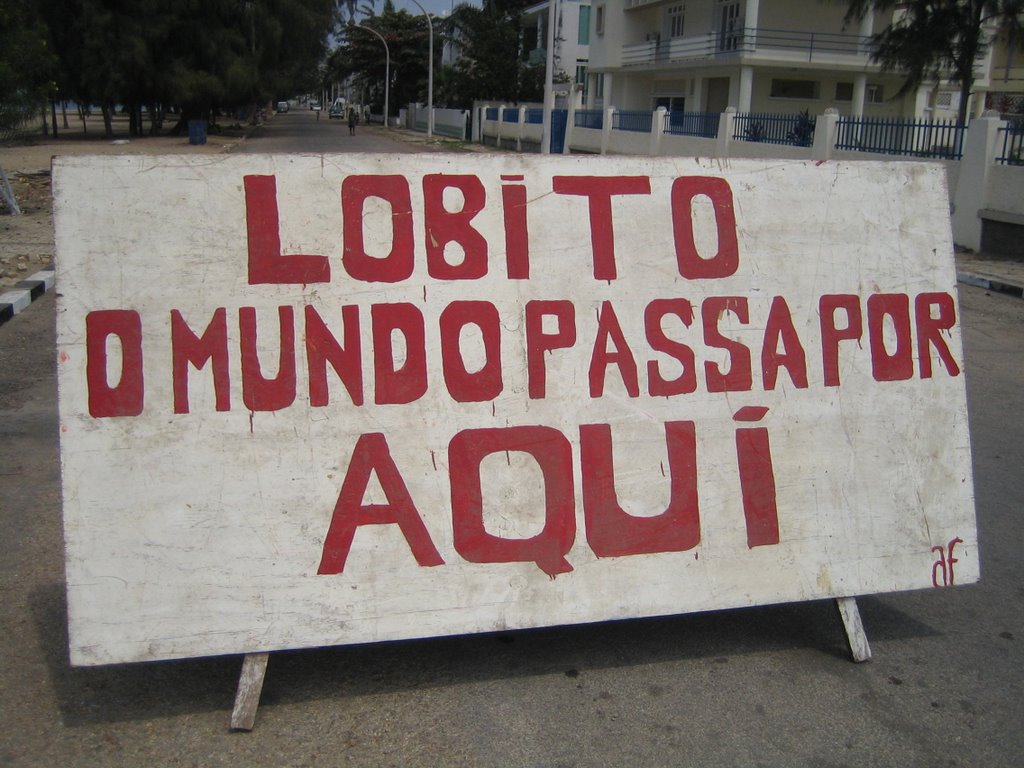
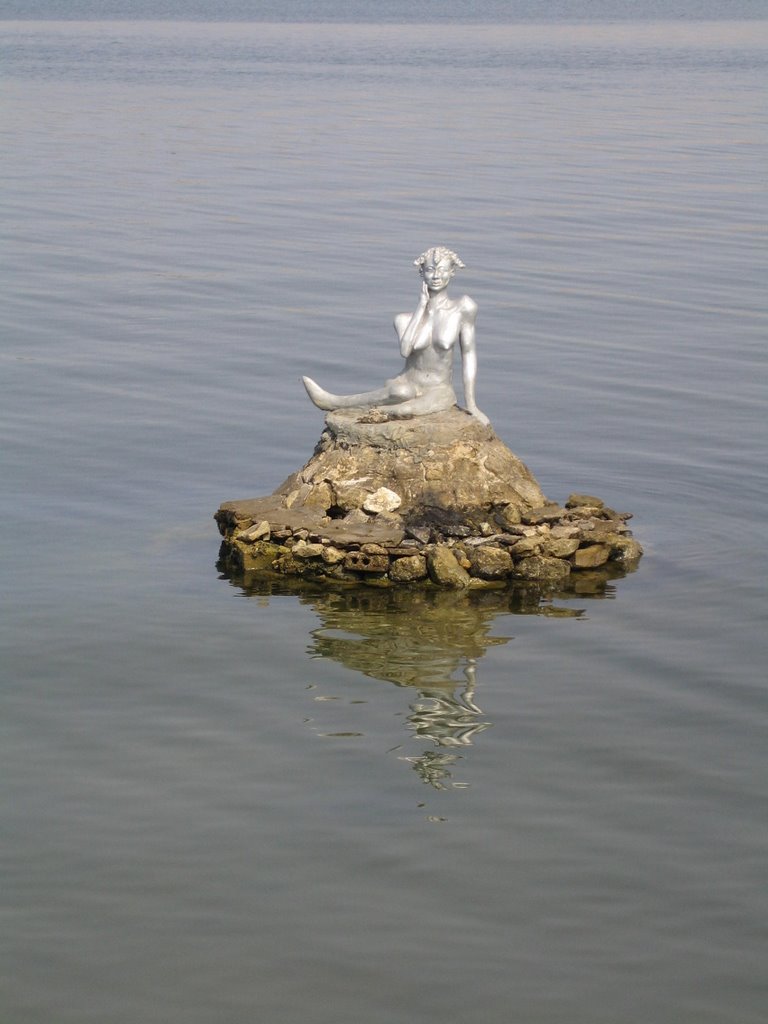
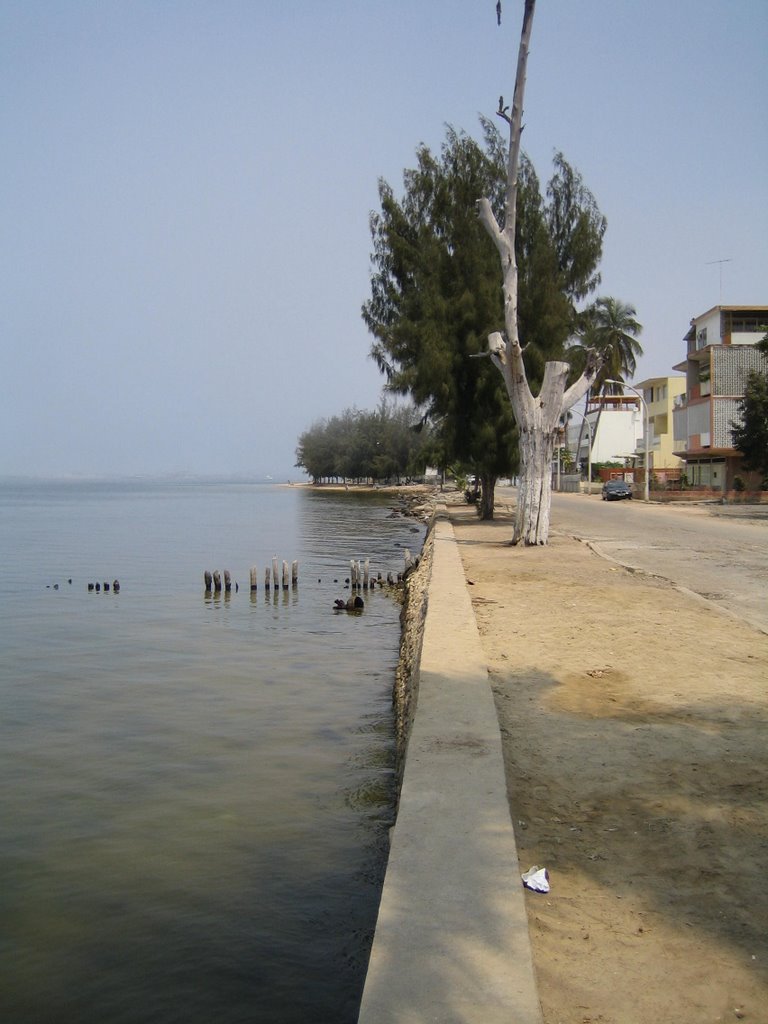
I'm posting some pictures of Lobito I took this weekend. The first is a sign that says "Lobito: The World Passes Through Here." Now, you might laugh... until you see all the Portuguese, Brazilians, Norwegians, and Americans that live here, mostly working for oil companies. The sign was used as a blockade for Lobito Day then taken down. The second is a picture of a sculpture that is in the port. There's no explanation for her, just one of those things something thought would look good among all the tankers. The third is a picture of the bay side of Restinga, the peninsula-like neighborhood where I will be living. (The other side is ocean.) My coworker lives steps away from here and has some kayaks that he takes out to go fishing. It's still too cold to go swimming (according to the Angolans- it's about 72 degrees right now), but in a few months it should be great.

Tuesday, September 05, 2006

Alas, I am still stuck at the Turimar Hotel in Lobito. This place is decent, but I am getting really anxious and am ready to move into my apartment. A coworker and I stopped by Friday afternoon (9/1) to check on it- it’s looking much better, with new floor and wall tiles, and the new washing machine, stove, and hot water heater are there too. Not installed *just* yet, but in the apartment. Exciting! However, the bathroom was in a real mess and didn’t look like it would be ready soon. Hopefully I can move in by next weekend, since it looks like I will be going out to the field next week.

Yes, I already have work to do, which is nice. I will be conducting a train-the-trainer session for a group of community leaders. These leaders will be running a grain mill business, something new to these communities. Because of the 30 yr civil war, most businesses were destroyed (along with homes, etc) and there's no real business culture here. This is where I come in- I’ll be giving a training on basic accounting and creating a business plan. I’m happy to: (a) feel useful; and (b) be doing something related to microenterprises even though that is not one of the specific projects that we run in Angola.

Yesterday (Saturday 9/2) was great day: I walked up and down Restinga. As you go down to the end, you can see the more fashionable, fancier houses. Some of them are brand new, a sign that investment is coming back to Lobito. On the way back to the hotel, I ran into Mark, an American coworker. He invited me back to his house to hang out for the afternoon. It was incredibly nice to just be able to relax at a home, even if it wasn’t my own home! His Angolan girlfriend, Domingas, made calulu and funge for lunch. Calulu is a stew made with dendem (red palm oil; dendê in Brazil), okra, and other veggies. Funge is harder to explain; it’s made of finely ground up corn, water and salt, and then pounded into a paste. Try to imagine a cream of wheat that’s really dry, and you get the idea. It has no flavor, but it absorbs what ever it’s eaten with and is quite filling. Domingas says it tastes better when it’s eaten with your hands.

That night was the big Lobito Day celebration. The presidential visit rumors proved false, but it was still quite fun. There was a stage set up for live music and tons of vendors selling beer, barbequed chicken and meat, and popcorn. The music ranged from the ridiculous- a woman with a horrible voice that was effectively booed off the stage; to music sung in Bundu, one of the local traditional languages; and to kizombo, the most popular Angolan music. The most thrilling moment of the night was a fireworks display. This truly sent a shock through the crowd; Domingas said they only do fireworks on New Year’s so this was a big deal. Compared to displays in the States, it was average, but for Angola it was AMAZING. I loved seeing how excited everyone got- hearing the squeals and laughter was as exciting to me as the fireworks were to them.

Thursday, August 31, 2006

In Lobito- finally!

I have finally arrived in Lobito, the city where I will be spending the next year. Getting here was interesting. The domestic airport in Luanda looks rather like a bus terminal. In true Soviet style, you must pass through several checkpoints before getting on the plane. There is the checkpoint to go to the ticket counter; the checkpoint at the ticket counter; the immigration check point (yes, even domestic travel requires immigration paperwork); the checkpoint to get the bus to the plane; the checkpoint to identify your luggage before they load it; and, finally, the checkpoint to get on the plane. The Lobito airport is really just an air control tower and a table set up outside for- you guessed it!- another checkpoint.

I haven’t had much time to explore yet- I arrived late afternoon on Tuesday and went to work at 8 the next morning. I am staying at a hotel until my apartment is ready. They said it would be ready by Friday, but after looking at it yesterday, I highly doubt it. The apartment itself is nice, but currently filthy and lacking any appliances I would need (fridge, stove, etc.). I will be living in the bairro of Restinga, which is the most upscale neighborhood of Lobito. Restinga is on a peninsula of sorts: the ocean in on one side, and the bay/port is on the other. I think upscale in Luanda would follow most Westerners’ perception of upscale- but not in Lobito. Some of the houses are quite nice, but not so luxurious looking (except maybe the ex-pat oil workers’ houses). The building my apartment is in would be in the worst ghetto if it were in the US- here it is quite nice. The best thing about my apartment is the view from the veranda. I am on a 5th floor walk-up (I don’t know how I’m going to get my luggage up the stairs!), and have a great view of the bay, ocean, and my rich neighbor’s house. Should make for some good spying!

This Saturday is Lobito Day. Supposedly the President is coming, which should be interesting. The entertainment in Lobito is provided by relotes, little shacks that have a few tables and chairs set up, serve food and open up a little dance floor. Right before I arrived the government shut dozens of them down and in their place put up signs that say “Lobito is a city that likes cleanliness.” (This, of course, in a city where you have roaming packs of goats that eat the trash.) Many people think this was done in anticipation of the President’s visit. A coworker doesn’t think he is coming, because they would have fixed the potholes (crevasses, really) in the streets where the celebration will be held. We shall see!

Monday, August 28, 2006

Luanda: The only city with more Hummers than Houston

I have arrived safe and sound in Luanda, after a 30 hour journey. It was quite long and included an 8 hour stay in Terminal 4 of Heathrow airport. The only thing for me to do was walk the length of the terminal; in all I probably walked 5 miles that day. I hoped the walking would help me sleep on the plane, but no such luck. On the flight there were several foreigners, mostly European (Portuguese, English, and Norwegian) and employees of oil companies. When we got to the immigration area, we had to get our health cards, complete with Yellow Fever vaccination, stamped by an official. The lines were extremely long- except if you were an oil company employee. Those lucky few just presented their cards and said, “Chevron” or “Total” and were directed to shorter, quicker lines.

I am still a bit jet-lagged (ready for bed at 6 pm). The staff here has been very nice; coming in on their days off to take me out to eat and make sure I am adjusting well. I have gotten two driving tours of Luanda so far; not sure what to think so far. Some parts could pass for Brazil- colonial buildings along palm-lined, waterfront streets. Most of it, however, is a reminder that this is one of the poorest countries in the world. Actually, that’s not quite accurate; there’s plenty of money, it’s just in the hands of a select few. For example, one notable thing about this city is the number of luxury cars. Perhaps it’s just the contrast against the jalopies, but there are tremendous numbers of fancy cars: BMWs, Hummers (I've seen 5 so far, oncluding one decorated with the image of the 2006 Angolan World Cup team), Mercedes, Audis, and Porsches. I’ve never seen anything like it in the developing world.

The saddest thing about these expensive cars- and the junky ones, too- is that no one knows how to drive them. In the three days that I have been here, a car I have been in has been hit twice (minor hits, thankfully) and witnessed two other hits. Meu Deus! Driving in this city is truly an adventure- one I hope to never undertake.

Monday, August 21, 2006

A tradition as old as dirt


I had the pleasure of attending the Iowa wedding of two good Peace Corps friends this weekend. It was a great time all around, enhanced by a visit to the Iowa State Fair. The top three highlights of the fair were:

THE BUTTER COW: A life-sized cow carved entirely out of butter
THE BIG BULL: The super bull of the fair, weighing in at over 3000 lbs. It was a big as a rhinocerous!
FRIED TWINKIE ON A STICK: Exactly what it sounds like. Not so tasty, but worth it for the bragging rights.

A healthy dose of Americana before heading off to Angola!

Sunday, July 23, 2006

I really do miss New York. Posted by Picasa